Retractable Roof vs Fixed Bioclimatic Pergola: Which System Is Right for You?
Comparing two distinct outdoor living solutions: the adjustable louvre pergola (Luxa 700) versus the fully retractable roof (Luxa 800). Understand the key differences in function, weather protection, cost, and design flexibility.
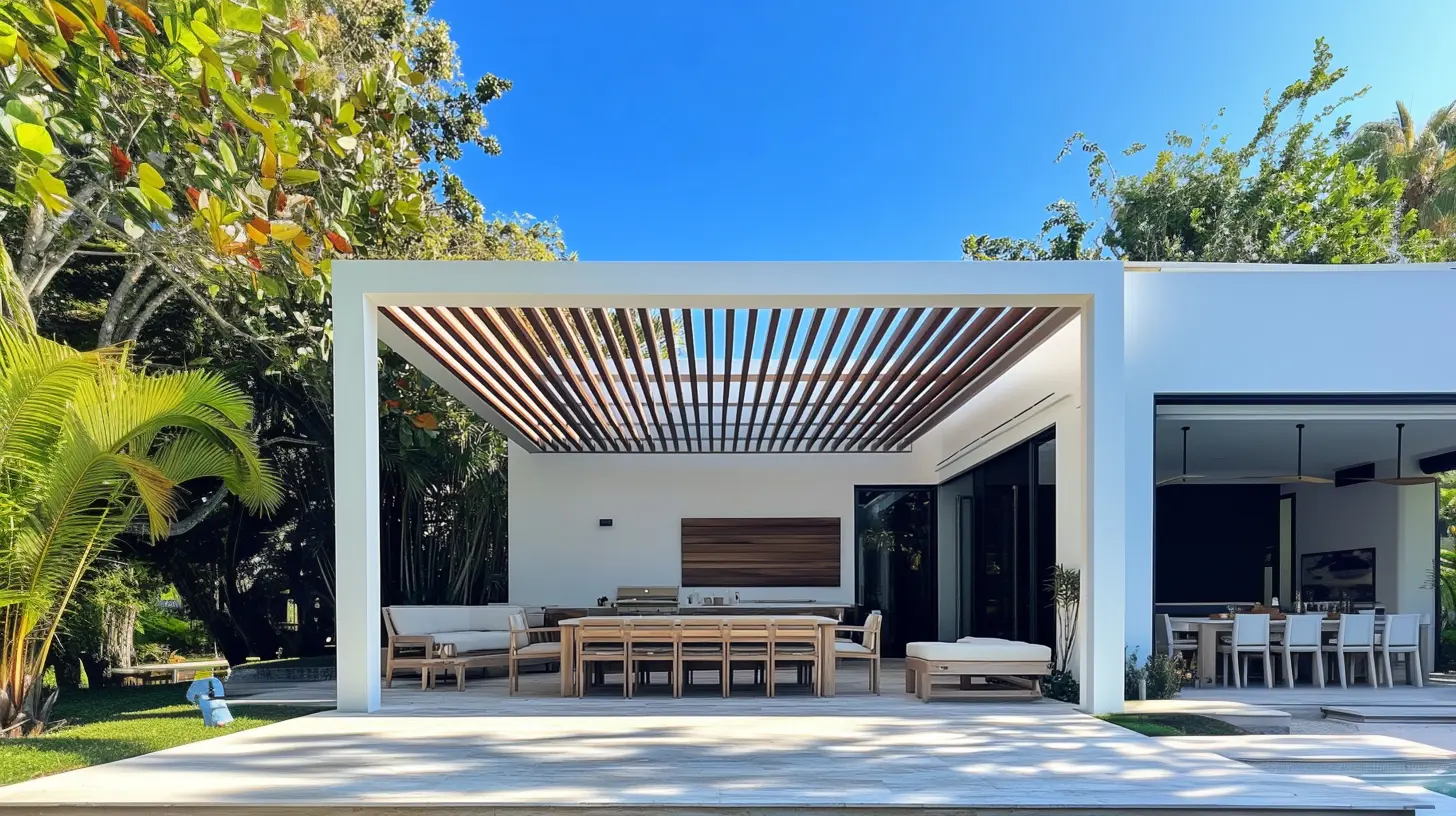
When planning an outdoor living space, one of the most important decisions is choosing between a fixed bioclimatic pergola and a fully retractable louvre roof. Both systems deliver shade, weather protection, and year-round usability — but they operate on fundamentally different principles. This guide compares the two approaches and helps you choose the right system for your home or commercial project. ## Introduction: Two Different Solutions A fixed bioclimatic pergola (such as the Luxa 700) features aluminium louvre blades that tilt between open and closed positions, typically up to 115°. The louvres remain part of the roof structure at all times, providing variable shade and ventilation. A retractable louvre roof (such as the Luxa 800) takes a different approach: the louvres slide open horizontally, retracting completely to reveal an open sky. When extended, they provide the same weather protection as a fixed system. When retracted, the roof effectively disappears. The choice between these two systems depends on your climate, aesthetic preferences, budget, and how you envision using your outdoor space. ## How Fixed Bioclimatic Works: The Luxa 700 The Luxa 700 is a motorised bioclimatic pergola where louvre blades are permanently mounted to an aluminium structural frame. The motor drives each blade through a synchronized rotation mechanism, allowing them to tilt from fully open (to allow 100% solar transparency and natural ventilation) to fully closed (forming an interlocking, watertight roof). Key operating principle: The louvres remain visible and part of the design whether open or closed. You adjust the angle to modulate light, shade, and air flow throughout the day. Structural features: - All-aluminium construction with powder-coated TIGER Coatings finish - Louvres tilt up to 115° (not retract) - Concealed drainage channels route rainwater silently through the columns - Maximum expansion 4 metres between supports - Available sizes: 3×3m, 3×4m, 3×5m, 3×6m, 4×3m, 4×4m, 4×5m, 4×6m - Manual version (Luxa 500) available with gear/crank operation - 98% recyclable materials Aesthetics: The Luxa 700 presents a clean, minimalist look with visible louvres in the open position. Some architects value this refined grid pattern; others prefer the complete disappearance offered by retractable systems. ## How Retractable Louvre Roof Works: The Luxa 800 The Luxa 800 operates on an entirely different mechanical principle. Instead of pivoting louvres, the Luxa 800 features fully retractable blades that slide open horizontally, retracting completely into one or both end columns. When extended, the blades interlock to form a weathertight roof. When retracted, the opening is completely clear — no visible structure, no louvre grid. Key operating principle: The roof is either fully closed (maximum weather protection and shade) or fully open (unobstructed sky view). There is no intermediate position; the system does not tilt. Structural features: - All-aluminium construction with TIGER Coatings finish - Blades slide open for complete open-sky exposure - Motorised with integrated wind and rain sensors - Four-season weather protection when closed - Can be integrated with side elements (glass walls, zip screens) - 98% recyclable materials Aesthetics: When open, the Luxa 800 provides an uninterrupted view of the sky with no visible roof elements. When closed, it functions as a complete weathertight shelter. This makes it ideal for architects seeking a minimal, modern aesthetic. ## Key Comparison Table: Fixed Bioclimatic vs Retractable Operating principle: The Luxa 700 offers infinitely variable louvre angles from 0° (closed) to 115° (open). The Luxa 800 operates in two discrete states: fully closed or fully open. The 700 is best for modulating light and shade throughout the day; the 800 is best for switching between complete sky exposure and full protection. Visual presence: With the Luxa 700, louvres are always visible — either as a closed roof or an open grid pattern. This can be aesthetically appealing but is never invisible. The Luxa 800 disappears entirely when open, offering maximalist minimalism. Weather protection: Both systems provide identical watertight protection when fully closed. The Luxa 700 offers intermediate positions (useful in mild rain or partial shade). The Luxa 800 offers all-or-nothing protection. Wind and snow tolerance: The fixed Luxa 700's permanent structure handles high wind and snow loads efficiently because the louvres act as structural bracing. The retractable Luxa 800 must be fully closed in severe weather — its advantage is the ability to open during calm, clear conditions. Space underneath: The Luxa 700 occupies consistent headroom whether open or closed (louvres remain in place). The Luxa 800 retracts into the columns, offering maximum vertical space when open. Motorisation: Both systems are motorised and can include integrated wind sensors, rain sensors, and remote/app control. The Luxa 700 also offers a manual (crank-operated) Luxa 500 option. Cost: The Luxa 700 is typically less expensive than the Luxa 800 because the mechanical system is simpler. Retractable systems require more complex sliding tracks and motor mechanisms. ## Weather Performance: Which System Protects Better? Fixed bioclimatic (Luxa 700): Excellent all-weather performance. The interlocking louvre design creates a watertight seal when closed, even in heavy rain. The 115° tilt allows fine-tuning — you can partially close the louvres in light rain while still admitting fresh air and natural light. Concealed drainage ensures water runs silently through the structural columns rather than dripping at the edges. Retractable (Luxa 800): Equally excellent weather protection when fully closed — the blade interlock creates a complete watertight barrier. However, the system must be fully closed to achieve this protection. In uncertain weather (afternoon showers forecast), some users find it less convenient than a fixed system you can partially adjust. The advantage: on clear days, you can fully retract the roof, something the fixed system cannot do. Competitor context: Renson's Camargue (fixed tilt-only pergola, max 90° opening) offers less versatility than the Luxa 700. The Renson Camargue Skye (retractable, 150° rotation, rated for 120 km/h wind and 70–100 kg/m² snow) is a direct Luxa 800 competitor, offering slightly wider opening angles but similar all-or-nothing operation. ## Energy Efficiency and Climate Control Fixed bioclimatic (Luxa 700): By tilting louvres to control solar gain on adjacent glass facades, you can reduce summer cooling loads by 30–40% — without blocking views or daylight entirely. The variable angle means you can continuously optimize based on the sun's path. Winter sunlight can be admitted (louvres tilted open) to warm interior spaces passively. Retractable (Luxa 800): Offers the same solar-gain reduction *when closed*, but the all-or-nothing operation is less nuanced. When open, you gain no shading benefit at all. For buildings where moderate, continuous shading is preferable, the fixed system may offer superior seasonal energy performance. For spaces where users prefer either "full sun" or "full shade," the retractable system is more intuitive. Both systems: Dramatically reduce the lifespan of fabric awnings and roll-down blinds, which degrade under UV and wind stress. Aluminium louvres simply don't degrade, making them more sustainable and cost-effective over 20+ years. ## Cost and Return on Investment Luxa 700 (fixed bioclimatic): Typically €8,000–€20,000 for a single 4×4m motorised module, depending on coating specification, automation features, and installation complexity. Manual Luxa 500 versions can be 20–30% cheaper. Luxa 800 (retractable): Typically €15,000–€30,000 for a single 4×4m module due to the more complex sliding mechanism and motorisation. Premium positioning reflects the additional engineering and mechanism cost. ROI context: Both systems reduce cooling costs, extend outdoor usability, and add architectural value. A well-specified pergola can increase property value by 5–8% and is often tax-deductible as a home improvement in many EU jurisdictions. The ROI window is typically 8–12 years through a combination of energy savings and usage extension. Competitor pricing: Renson Camargue systems typically range €6,000–€18,000 (fixed); Camargue Skye retractable systems range €12,000–€28,000. Alcodec pricing is competitive in both categories. ## Which One Should You Choose? Choose the Luxa 700 (fixed bioclimatic) if: - You want infinitely variable light and shade control throughout the day - Your climate experiences frequent light rain; you prefer not to fully close the system every time - You want the lowest cost option with excellent weather protection - You appreciate the minimalist aesthetic of visible louvres in the open position - You need a manual-operated option (Luxa 500) without electrical infrastructure - You want maximum energy efficiency through continuous solar-gain modulation Choose the Luxa 800 (retractable) if: - You prioritize complete sky views and unobstructed outdoor aesthetics when the roof is open - Your climate is predominantly clear or rainy (binary weather, not transitional) - You want the roof to "disappear" when not needed - You prefer intuitive operation: fully open for sun or fully closed for protection (not partial positions) - Budget is secondary to achieving a minimalist architectural vision - You want maximum vertical space under the structure when open For most residential applications: The Luxa 700 offers superior practicality and cost-effectiveness. The ability to fine-tune louvre angles throughout the day, combined with lower cost and simpler operation, makes it the default choice for homeowners. For commercial or premium residential projects: The Luxa 800's ability to completely retract appeals to architects and developers seeking cutting-edge aesthetics and maximum design flexibility. The additional cost is justified in high-value properties. ## Conclusion Both the fixed bioclimatic pergola (Luxa 700) and the fully retractable louvre roof (Luxa 800) are engineering solutions that solve real problems: excessive heat, insufficient shade, and limited outdoor usability in variable climates. The choice between them is not about one being objectively "better" — it's about matching the system to your climate, aesthetic priorities, budget, and how you actually use your outdoor space. For most European homeowners, the Luxa 700's variable louvre control delivers superior year-round practicality and value. For architects and clients pursuing cutting-edge design, the Luxa 800's ability to completely retract justifies the additional investment. Both are built to last 25+ years with minimal maintenance, and both significantly improve the functionality and market value of your property.